
Criminal Court Cases in Bronx County
Two courts keep the main Bronx County criminal case records. NYC Criminal Court, Bronx County, handles misdemeanors, violations, arraignments, summons matters, and the first steps in felony prosecutions. Its courthouse is at 215 East 161st Street, Bronx, NY 10451. The general line is 718-618-2400, and the clerk can be reached at 718-618-2460. An early felony file may carry a modern CR- docket even though the same prosecution later moves elsewhere.
After a grand jury indictment, Bronx Supreme Court, Criminal Term, handles the felony at 265 East 161st Street. Its main line is 718-618-3100, while the Chief Clerk's office is 718-618-3000. The Central Clerk is on the second floor. These are separate court files, not duplicate views of one database. A sound Bronx County court case lookup therefore checks which court had the matter at the stage being researched.
Bronx County Felony Case Handoffs
A felony arrest does not begin in Supreme Court. NYPD sends the arrest and fingerprint event to state systems, the Bronx District Attorney screens the complaint, and Criminal Court conducts the first appearance. The prosecutor may decline the charge, reduce it, replace it, or seek a grand jury indictment. Only an indicted felony moves into Bronx Supreme Court. That sequence explains why a searcher may find a Criminal Court docket but later need an indictment number and a Supreme Court certificate.
Do not treat the police charge as the final court charge. The 2024 Bronx District Attorney report counted 48,112 NYPD arrest submissions. Of those, 58 percent had a misdemeanor top arrest charge, 19 percent had a violent-felony top arrest charge, and 23 percent had another felony as the top arrest charge. Those categories describe intake, not final outcomes. The court file shows what prosecutors filed and what the judge ultimately decided.
Bronx County Case Record Searches
WebCriminal is the free starting point for a public, pending Bronx County criminal case. It offers defendant, case-number, and calendar modes. Completed matters, sealed files, and warrant information are not shown, so a blank result is not a complete no-record finding.
- Choose defendant search for a name, case search for a known docket, or calendar search for a scheduled Bronx court appearance.
- Enter at least three letters of the last name and two of the first name, or enter the complete modern case number.
- Compare the court, docket, displayed name, charge, status, part, and next appearance rather than trusting a name match alone.
- Check the other Bronx court when the history suggests a felony indictment or transfer from Criminal Court to Supreme Court.
- Ask the deciding clerk for copies or a Certificate of Disposition when the case is complete or the online detail is not enough.
For a broader public court-history check, OCA Criminal History Record Search uses an exact name and date of birth and costs $95 per search. It covers public pending cases and convictions from participating New York courts. It is not fingerprint-confirmed, excludes sealed matters, and may miss name variations or older town and village records.
| Field Label | Type | Required | Notes |
|---|---|---|---|
| Defendant Last Name | Text | Yes in name mode | First three letters minimum |
| Defendant First Name | Text | Yes in name mode | First two letters minimum |
| Case Number | Text | Yes in case mode | Use the full CR-######-YYSU style number |
| Court | Dropdown | Calendar mode | Select the criminal venue |
| Courtroom/Part | Dropdown or text | Calendar mode | Use a part such as D31 or D44, not a judge name |
| Date | Calendar | Calendar mode | Use the scheduled appearance date |
Finished Bronx County Court Cases
WebCriminal's focus on active appearance data can make a completed Bronx County court case seem to vanish. The clerk is the fallback. A Certificate of Disposition is the court-certified result and is often the clearest way to resolve an old charge, a changed charge, or a portal entry that no longer appears. Criminal Court asks for the defendant's name, aliases, date of birth, docket number, and any known arrest, charge, or conviction details.
At Bronx Criminal Court, the researched fee is $5. An in-person request requires photo identification. A mailed request needs a $5 money order payable to Clerk of Court, a self-addressed stamped envelope, and a copy of photo ID; personal checks are not accepted. Bronx Supreme Court's Central Clerk charges $10 for a finished felony disposition. Court-appointed counsel and qualifying public-benefit recipients may present proof for an exemption. Use the court that entered the final outcome, since the lower-court certificate cannot certify a later Supreme Court judgment.
Note: A certificate confirms the court outcome; it is not the same product as a fingerprint-linked DCJS rap sheet.
What a Criminal Case File Contains
A Bronx County criminal case file records the prosecution as filed and decided. It may contain an accusatory instrument, motion rulings, calendar activity, counsel appearances, court orders, a plea or verdict, and a sentence. Some filed papers, exhibits, or transcripts require a separate clerk request and are not free WebCriminal downloads. Compare the docket or indictment number, court, and disposition before concluding that a similar name belongs to the same person.
Public case views can show the court, filing or arrest date, next appearance, courtroom or part, status, charge text, attorney, and calendar purpose. They withhold full identifiers, confidential grand jury material, protected victim details, and youthful-offender matters.
| Case Number and Court | The docket or indictment identifier and the Bronx court that holds that stage of the case. |
|---|---|
| Charging Document | The complaint, information, or indictment that states the filed accusations. |
| Docket Entries | Appearances, motions, hearings, adjournments, orders, and other procedural events. |
| Hearing Dates | Past and next appearances, courtroom or part, and calendar purpose when public. |
| Disposition | The charge-by-charge result, such as dismissal, ACD, plea, acquittal, or conviction. |
| Sentence | The court-imposed term and conditions after a conviction. |
Bronx County DA Data Limits
The Bronx District Attorney publishes dashboards for arraigned cases from 2019 forward. They can help explain broad patterns by charge type, severity, and outcome. They cannot identify an individual defendant or replace WebCriminal and the court clerk. Aggregate counts also use definitions that matter. An arrest submission may change before arraignment, and one person's repeat arrest events can be counted more than once.
The Bronx DA contact directory shows the office and its named bureaus. That official source also supplied the captured image below.
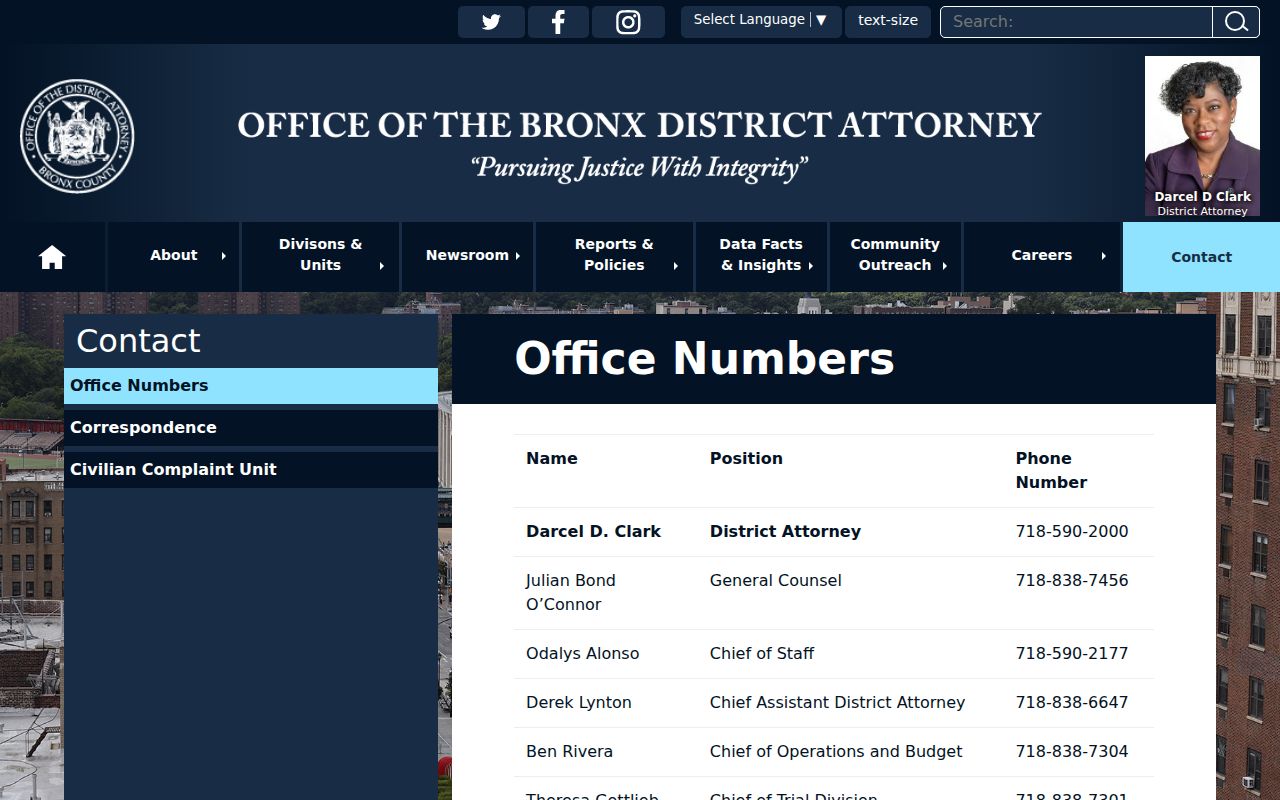
The directory helps route prosecutor-office questions, but the court clerk remains the custodian for certified dispositions and filed Bronx County criminal case records.
Criminal Case Stages in Bronx County
A Bronx County court case may change shape as it moves. The Bronx DA screens the police complaint before arraignment. Criminal Court then addresses the accusatory instrument and release status. A misdemeanor may stay there through motions, plea or trial, disposition, and sentence. A felony can move through grand jury action to Bronx Supreme Court, where the indictment becomes the controlling charge document.
Case flow: Charges Filed › Arraignment › Pretrial › Plea or Trial › Disposition › Sentencing
Not every case reaches every listed point. A prosecutor may decline to proceed, a judge may dismiss a charge, a matter may end in an adjournment in contemplation of dismissal, or a defendant may plead before trial. The final disposition must be read charge by charge. An appeal creates another record layer and does not rewrite the trial clerk's docket into a full appellate file.
Bronx County Court Record Terms
A few local identifiers prevent mistaken searches. They describe different stages or agencies, and they are not interchangeable.
- Docket number
- The Criminal Court case identifier, including the modern
CR-format. - Indictment
- The grand jury's felony accusation that moves the prosecution to Supreme Court.
- NYSID
- The fingerprint-linked New York State Identification Number maintained through DCJS.
- Book and Case
- The NYC Department of Correction identifier used only after admission to city custody.
- Disposition
- The formal outcome for a charge or case, not merely the last listed appearance.
The same prosecution can carry more than one identifier. Use the court's docket or indictment number for a clerk request, and reserve NYSID or Book and Case for the state-history and custody systems that issue them.
Access Rules for Case Records
Court access in Bronx County does not run through New York Freedom of Information Law. The judiciary follows clerk procedures and court rules, while FOIL governs executive agencies such as NYPD and NYC DOC. A request for the filed case belongs with the court clerk. A request for a police arrest report belongs with NYPD. A request for one's official state criminal history belongs with DCJS Personal Record Review.
Sealed cases, youthful-offender matters, confidential grand jury material, full personal identifiers, and protected victim information are not public. Favorable terminations are generally sealed under CPL 160.50. Eligible records may also be sealed under Clean Slate or a court order. Online views can omit papers that remain available at the clerk, but the clerk cannot disclose a legally sealed file to an ordinary public requester.
Bronx County Court Access Help
The East 161st Street court corridor serves most in-person Bronx County criminal case needs. Criminal Court arraignments other than desk-appearance tickets operate daily, while other clerk offices generally follow weekday hours. Security screening is required. There is no public on-site or adjacent parking, so allow time for transit and entry.
All courtrooms have assistive-listening capability, and elevators reach public floors. The accessible route for Criminal Court uses the Family Court side at 900 Sheridan Avenue. Accommodation requests may go through the clerk or the online court process. Free court interpreters are also available; the statewide language-access line is 646-386-5670. These services matter when the record must be reviewed at a counter rather than through a portal.
Bronx Criminal Court
215 East 161st Street
Bronx, NY 10451
718-618-2400
Clerk: 718-618-2460
Bronx Supreme Court
265 East 161st Street
Bronx, NY 10451
718-618-3100
Chief Clerk: 718-618-3000